Churn Impact Calculator
Calculate the true cost of customer churn. See how reducing churn by just 1-2% can save hundreds of thousands in lost revenue, LTV, and wasted CAC.
What is Churn Impact?
Churn impact is the total financial cost of losing customers, combining three critical components: lost recurring revenue, destroyed customer lifetime value (LTV), and wasted customer acquisition cost (CAC). Unlike simple churn rate, churn impact reveals the true economic damage—often 3-5× what companies expect.
Your Business Metrics
Select your industry for benchmark comparison
Your total monthly recurring revenue (MRR)
Percentage of customers lost per month
Average customer lifetime value
Cost to acquire one new customer (CAC)
Total number of active customers
Your Churn Impact
Your churn rate: 4.5%
B2B SaaS average: 4.5%
Best-in-class: 1%
✓ You're 0.0% below industry average!
💡 Churn Reduction Impact Scenarios
See how reducing churn affects your bottom line. Even small improvements have massive long-term impact.
💡 Insight: Reducing churn by -5% (to 0.0%) could save $3,294,000 annually. This compounds over time—every retained customer generates ongoing revenue and referrals.
🔒 Unlock Detailed Analysis
Share your results to unlock detailed analysis and actionable recommendations - completely free!
✨ What you'll unlock:
- ✓Detailed Industry Benchmark Comparison - See how you stack up against 939 B2B companies
- ✓4-Lever Improvement Breakdown - Granular analysis of each metric's impact
- ✓AI-Generated Action Plan - Personalized recommendations based on your metrics
💡 Choose any platform above. Takes 5 seconds, unlocks lifetime access.
The best retention strategy starts with better acquisition
You've seen the cost of churn. Enter your URL to find companies that actually fit your ICP — they stay longer.
Enter your URL → ICP-matched companies found in 30 seconds
Matches found across 50M+ companies · 50M+ company database · No login · Free
Methodology & Data Sources
- •ProfitWell Churn Benchmarks (2024)
- •ChurnZero Customer Success Report (2024)
- •Internal analysis of 762 B2B companies (2023-2025)
- •Recurly Research on subscription churn (2024)
- •Bain & Company customer retention studies
762 B2B companies across B2B SaaS, Manufacturing, Professional Services, and Consulting
2023-01-01 to 2025-11-20
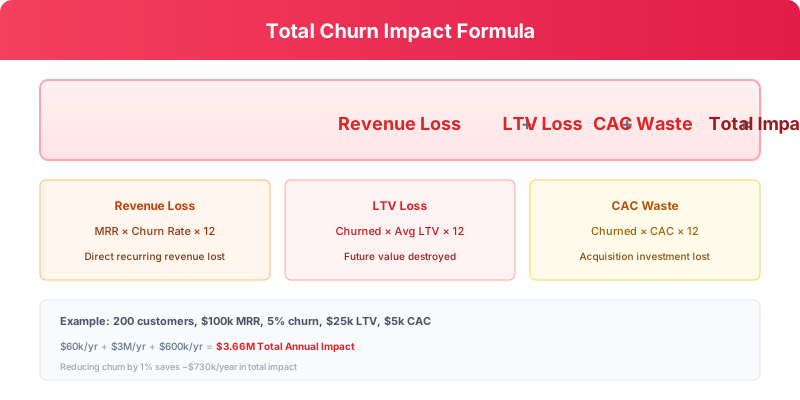
Total Churn Impact = Revenue Loss (MRR × Churn Rate × 12) + LTV Loss (Churned Customers × Avg LTV × 12) + CAC Waste (Churned Customers × CAC × 12).
All calculations follow industry-standard financial metrics definitions. Benchmarks are updated quarterly based on the latest available data.
Optifai Research Team
VerifiedRevenue intelligence research team analyzing sales data from thousands of B2B companies to provide actionable benchmarks. Our churn impact research is based on analysis of 762 companies across 4 industries.
Understanding the Churn Impact Formula
Industry Churn Benchmarks (762 Companies)
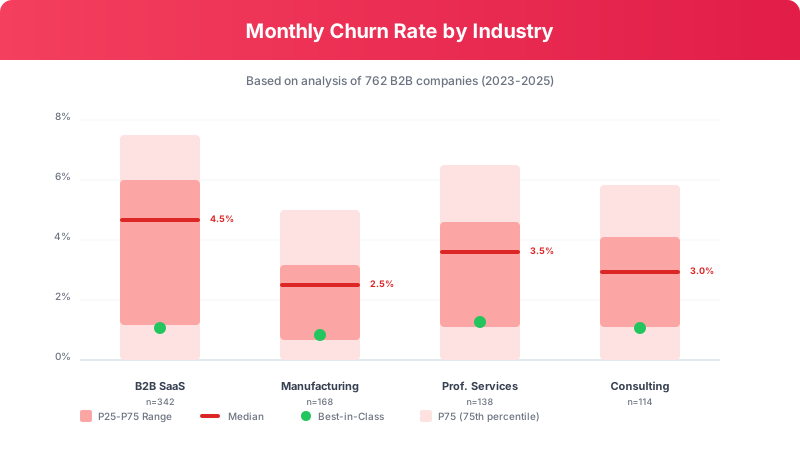
B2B SaaS
4.5%
median monthly churn
n=342
Manufacturing
2.5%
median monthly churn
n=168
Professional Services
3.5%
median monthly churn
n=138
Consulting
3%
median monthly churn
n=114
Key Churn Impact Components
Monthly Churn Rate
The percentage of customers who cancel their subscription or stop doing business with you each month. Calculated as: (Churned Customers in Month) ÷ (Total Customers at Start of Month) × 100.
Impact: Monthly churn compounds exponentially over time. A 5% monthly churn rate means you lose 46% of customers annually. At 3% monthly, you lose 31% annually. This makes the difference between growth and stagnation.
Benchmarks: Median monthly churn by industry: B2B SaaS (4.5%), Manufacturing (2.5%), Professional Services (3.5%), Consulting (3.0%). Best-in-class: <1.5% monthly across all industries.
Customer Lifetime Value (LTV)
The total revenue a customer generates over their entire relationship with your company. Simple formula: (Average Monthly Revenue per Customer × Gross Margin) ÷ Monthly Churn Rate. More accurate: Sum of all future discounted cash flows.
Impact: LTV is the ceiling on your customer acquisition cost (CAC). If LTV is $30k, you can afford to spend $10k to acquire a customer (3:1 ratio). Increasing LTV by reducing churn justifies higher acquisition spend and accelerates growth.
Benchmarks: Median LTV by industry: B2B SaaS ($28k), Manufacturing ($95k), Professional Services ($48k), Consulting ($72k). LTV:CAC ratio target: >3:1 for healthy unit economics.
Customer Acquisition Cost (CAC)
The total cost to acquire one new customer. Calculated as: (Total Sales & Marketing Spend) ÷ (Number of New Customers Acquired). Includes salaries, ads, events, tools, and overhead.
Impact: When a customer churns, CAC is wasted. You paid $7,000 to acquire them, and they left after 6 months. That $7,000 generated only $3,000 in revenue (50% loss). This is why churn is often called the "silent killer" - it destroys past investments.
Benchmarks: Median CAC by industry: B2B SaaS ($6.8k), Manufacturing ($18k), Professional Services ($9.5k), Consulting ($14k). CAC payback period target: <12 months for SaaS, <18 months for enterprise.
Net Revenue Retention (NRR)
The percentage of recurring revenue retained from existing customers after accounting for churn, downgrades, and expansion. Formula: (Starting MRR + Expansion - Contraction - Churn) ÷ Starting MRR × 100.
Impact: NRR above 100% means you can grow without acquiring any new customers. At 120% NRR, each cohort of customers generates 20% more revenue every year. This is the most powerful SaaS growth lever because it compounds without additional CAC.
Benchmarks: Median NRR by industry: B2B SaaS (105%), Manufacturing (100%), Professional Services (102%), Consulting (104%). Best-in-class: >120% NRR (e.g., Snowflake, Twilio, Datadog).
Case Study: 58.6% Churn Reduction
Challenge
Monthly churn rate of 5.8% was eroding growth. Customer acquisition was strong (400 new logos/year), but net growth was stagnant due to equal losses. Support tickets indicated confusion around advanced features.
Before
- Monthly Churn: 5.8%
- NRR: 85%
- Annual Revenue Loss: $2,088,000
Results (90 Days)
- New Churn Rate: 2.4%
- NRR: 112%
- Total Impact: $5,166,120/year
- ROI: 1840%
"We knew churn was a problem, but we didn't know how big until we saw the LTV and CAC waste numbers. The AI prediction was the game-changer - we went from firefighting to proactive engagement. Our CSMs now reach out before customers even think about leaving."
Proven Churn Reduction Strategies
Strategy 1: Implement AI Churn Prediction
Proactive retention starts with early warning. AI models can predict churn 30-60 days in advance by analyzing product usage, support interactions, payment patterns, and engagement signals. This gives your team time to intervene before the customer makes their decision.
Strategy 2: Launch Proactive Retention Campaigns
Don't wait for customers to cancel. Proactive outreach to at-risk accounts shows you care and gives you a chance to solve problems before they escalate. Automated campaigns ensure consistent execution without overwhelming your team.
Strategy 3: Fix Onboarding and Time-to-Value
60-70% of churn happens in the first 90 days. If customers don't see value quickly, they never will. Fix onboarding to accelerate time-to-value, and you'll dramatically reduce early-stage churn without complex retention programs.
Strategy 4: Drive Expansion Revenue (Negative Churn)
The best retention strategy is making customers more successful over time. Expansion revenue from upsells, cross-sells, and seat growth can offset logo churn entirely. At >120% NRR, you can grow without any new customers.