Coverage Model
Calculate if your pipeline is enough to hit quota based on your win rate and sales cycle.
Last updated: November 20, 2025 | Data refreshed quarterly
What is Pipeline Coverage?
Pipeline coverage model calculates the ratio of qualified pipeline to quota, indicating whether you have enough opportunities to hit your target given your historical win rate and deal slippage patterns.
Why It Matters
- Quota predictability: Coverage <2.5× means >50% chance of missing quota
- Early warning system: Identifies pipeline gaps before it's too late to fix
- Resource allocation: Determines where to focus effort (generation vs. closing)
- Stress reduction: Adequate coverage means less end-of-quarter pressure
Not the Same As
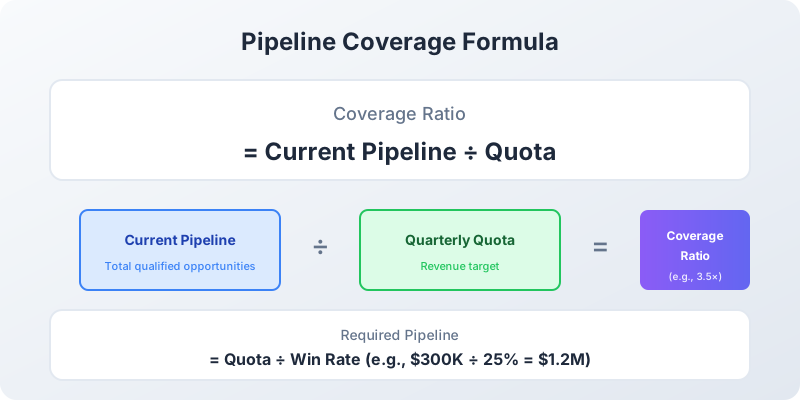
The Coverage Formula
Calculate Your Coverage
Your Pipeline Data
Your Coverage Analysis
Coverage Ratio
2.5×
B2B SaaS benchmark: 3.5× (Below benchmark)
Expected Close
$188K
$113K shortfall
Risk Level
⚡ Medium Risk
Needs careful monitoring
🔒 Unlock Detailed Analysis
Share your results to unlock detailed analysis and actionable recommendations - completely free!
✨ What you'll unlock:
- ✓Detailed Industry Benchmark Comparison - See how you stack up against 939 B2B companies
- ✓4-Lever Improvement Breakdown - Granular analysis of each metric's impact
- ✓AI-Generated Action Plan - Personalized recommendations based on your metrics
💡 Choose any platform above. Takes 5 seconds, unlocks lifetime access.
Understanding Each Component
Coverage Ratio
The ratio of qualified pipeline value to quota. Shows how many times your pipeline "covers" your target.
Coverage Ratio = Current Pipeline ÷ Quota
Why It Matters
Higher coverage provides buffer for deal slippage, unexpected losses, and timing issues. Most teams need 3-4× coverage to reliably hit quota.
Key Factors
- •Win rate: Lower win rate requires higher coverage
- •Deal slippage: Higher slippage needs more buffer
- •Sales cycle: Longer cycles need earlier pipeline
- •Deal size mix: Enterprise deals need higher coverage
Benchmarks
Excellent
>4.0× (strong buffer)
Good
3.0-4.0× (healthy)
Concerning
<2.5× (at risk)
How to Improve
- Set weekly pipeline generation targets (not monthly)
- Implement early-quarter pipeline blitz
- Reactivate dormant opportunities
- Increase outbound activity when coverage drops below 3×
Required Pipeline
The minimum pipeline value needed to achieve quota, based on your win rate.
Required Pipeline = Quota ÷ (Win Rate / 100)
Why It Matters
This tells you the absolute minimum pipeline needed. In practice, you need 20-50% more due to deal slippage and timing.
Key Factors
- •Win rate accuracy: Historical vs. aspirational
- •Deal stage distribution: Early stage has lower close probability
- •Seasonality: Some quarters have higher slippage
- •New vs. expansion: Different win rates apply
Benchmarks
Excellent
Good
Concerning
How to Improve
- Improve win rate to reduce required pipeline
- Segment win rates by deal type/size
- Add buffer for slippage (target 1.5× required)
- Track historical accuracy of required pipeline calc
Pipeline Gap
The difference between current pipeline and required pipeline. Negative = shortfall.
Pipeline Gap = Current Pipeline - Required Pipeline
Why It Matters
Quantifies how much additional pipeline you need to generate to reach safe coverage levels.
Key Factors
- •Time remaining: Gap urgency depends on days left
- •Generation capacity: Can you fill the gap in time?
- •Existing pipeline age: Old pipeline may not close
- •Deal size: Larger deals harder to add quickly
Benchmarks
Excellent
Good
Concerning
How to Improve
- Calculate gap early (Day 1 of quarter)
- Set intermediate milestones (Week 2, Week 4)
- Prioritize fast-cycle deals when gap is critical
- Pull forward expansion opportunities
Time-Adjusted Coverage
Coverage ratio adjusted for time remaining vs. average sales cycle.
Time Factor = Days Left ÷ Average Sales Cycle
Why It Matters
Late in quarter, only deals within closing window matter. Early-stage pipeline is irrelevant if cycle exceeds time left.
Key Factors
- •Days remaining: Constrains which deals can close
- •Sales cycle by stage: Later stages close faster
- •Deal acceleration potential: Can you compress cycle?
- •Quarter-end urgency: Buyers may delay to next quarter
Benchmarks
Excellent
Good
Concerning
How to Improve
- Focus on deals in late stages when time is short
- Accelerate deal velocity with mutual action plans
- Identify "fast-close" opportunities (expansion, renewals)
- Deprioritize long-cycle deals late in quarter
Real-World Case Study
How a B2B SaaS team improved quota attainment from 72% to 94%
Company Profile
Challenge: Team consistently at 72% quota attainment with 2.1× coverage and high end-of-quarter scramble.
Before
After (60 days)
What They Did
Pipeline Generation Cadence
4 weeks- •Implemented weekly pipeline generation targets (not just monthly)
- •Added early-month focus on net-new pipeline
- •Required 3.5× coverage by Day 15 of each quarter
Coverage increased from 2.1× to 3.4× by mid-quarter
Deal Qualification Framework
6 weeks- •Implemented MEDDPICC qualification criteria
- •Added mandatory multi-threading requirement
- •Created "Deal Risk" scoring (technical, commercial, timeline)
Win rate improved from 22% to 29% (+32%)
Pipeline Velocity Optimization
4 weeks- •Identified and removed stuck deals (>2× avg cycle)
- •Implemented stage-by-stage velocity tracking
- •Added automated follow-up sequences for stalled deals
Sales cycle reduced from 75 to 62 days (-17%)
Forecasting Accuracy
8 weeks- •Added weighted pipeline by stage
- •Implemented "commit" vs "best case" categories
- •Weekly deal review with probability adjustments
Forecast accuracy improved from 65% to 88%
+31%
Attainment
+62%
Coverage
-49%
Slippage
$2.4M
Revenue
“We went from constant end-of-quarter scramble to predictable, consistent performance. The key was building pipeline early and maintaining 3.5× coverage throughout the quarter, not just at the beginning.”
— VP of Sales, B2B SaaS Company (50-200 employees)
4 Strategies to Improve Coverage
Proven tactics to build and maintain healthy pipeline
Pipeline Generation Velocity
Build consistent weekly pipeline generation habits to maintain coverage throughout the quarter.
Implementation Steps
- 1Set weekly pipeline generation targets (e.g., $100K/rep/week)
- 2Front-load quarter with pipeline blitz (first 2 weeks)
- 3Implement "Pipeline Monday" - weekly review of generation metrics
- 4Create pipeline generation leaderboard with incentives
40-60%
Coverage Increase
Eliminates end-of-quarter scramble
Stress Reduction
2-3 weeks
Time to Implement
KPIs to Track
- Weekly pipeline created: Target = Monthly quota ÷ 3
- Day 15 coverage: Target ≥3.5×
- Net-new vs total: Target ≥60% new
Qualification Rigor
Improve win rate by qualifying harder and focusing on high-probability opportunities.
Implementation Steps
- 1Implement MEDDPICC or BANT across all deals
- 2Require multi-threading (≥3 contacts) for deals >$50K
- 3Create "Deal Risk Score" (technical, commercial, timeline)
- 4Remove unqualified deals from pipeline monthly
25-40%
Win Rate Increase
15-25% (fewer stalled deals)
Cycle Reduction
4-6 weeks
Time to Implement
KPIs to Track
- Win rate: Target >25%
- Qualification score completion: Target 100%
- Pipeline hygiene: Remove ≥10% unqualified monthly
Deal Acceleration Tactics
Compress sales cycles to close more deals within the quarter.
Implementation Steps
- 1Create mutual action plans for all deals >$25K
- 2Implement "next step" accountability in every meeting
- 3Add deadline-driven incentives (end-of-quarter pricing)
- 4Identify and remove bottlenecks (legal, procurement)
Forecast Accuracy
20-30%
Cycle Reduction
3-4 weeks
Time to Implement
KPIs to Track
- Sales cycle: Target <60 days
- Stage-to-stage time: Target <7 days
- Mutual action plan adoption: Target 100%
Forecast Accuracy Improvement
Better forecasting enables earlier action on coverage gaps.
Implementation Steps
- 1Implement weighted pipeline by stage
- 2Separate "commit" vs "best case" vs "pipeline"
- 3Weekly deal reviews with probability adjustments
- 4Track forecast accuracy by rep (reward accuracy)
+20-35 points
Forecast Accuracy
2-3 weeks earlier gap detection
Early Warning
4-6 weeks
Time to Implement
KPIs to Track
- Forecast accuracy: Target ≥85%
- Deal movement: Weekly stage progression
- Commit accuracy: Target ≥90%
Frequently Asked Questions
What is a good pipeline coverage ratio?
Most sales teams need 3-4× coverage to reliably hit quota. The exact number depends on your win rate and deal slippage. If your win rate is 25%, you need at least 4× coverage (because 100% ÷ 25% = 4). Add 20-50% buffer for slippage, and you get 4.8-6×. In practice, 3.5× is a good minimum target for most B2B companies.
How do I calculate required pipeline?
Required Pipeline = Quota ÷ Win Rate. For example, if your quarterly quota is $300K and your win rate is 25%, you need $300K ÷ 0.25 = $1.2M in pipeline. This is the mathematical minimum - in practice, add 25-50% buffer for slippage and timing issues, so target $1.5M-$1.8M.
When should I start building next quarter's pipeline?
Start building next quarter's pipeline by Week 6 of the current quarter (assuming 13-week quarters). If your sales cycle is 60 days, deals entered in Week 7 can close in Week 1 of next quarter. Top performers maintain continuous pipeline generation regardless of quarter boundaries.
How much pipeline should I add each week?
Target weekly pipeline generation = Monthly quota ÷ 3. For a $100K monthly quota, generate $33K in new pipeline per week. This ensures you're always building while closing, not just scrambling at quarter-end. Front-load the quarter (Week 1-2 at 150% of target).
What causes low coverage ratios?
Common causes include: (1) Inconsistent prospecting - only generating when pipeline is thin, (2) Poor qualification - low win rate requires more pipeline, (3) Long sales cycles - deals don't close fast enough to maintain coverage, (4) High deal slippage - losing 30%+ of expected closes. Address the root cause, not just the symptom.
How does win rate affect required coverage?
Win rate is inversely proportional to required coverage. If your win rate improves from 20% to 30%, your required coverage drops from 5× to 3.3×. This is why improving win rate through better qualification is often more effective than simply adding more pipeline. Higher win rate = less work.
What is deal slippage and how does it affect coverage?
Deal slippage is when expected closes move to next quarter. Average slippage is 25-35%. If you expect $500K to close this quarter, $125K-$175K will likely slip. This means your actual close rate is win rate × (1 - slippage rate). Factor this into coverage calculations.
Should I remove unqualified deals from pipeline?
Yes, aggressively. "Zombie deals" (>2× avg cycle, no activity) inflate coverage artificially and hide the real gap. Remove 10-15% of pipeline monthly through rigorous qualification. It's better to know the truth early than be surprised at quarter-end. Quality over quantity.
How often should I review pipeline coverage?
Review coverage weekly, minimum. Daily for critical periods (last 3 weeks of quarter). Set alerts for coverage drops below 3×. The earlier you spot gaps, the more options you have to fill them. Late detection = limited options = missed quota.
What is time-adjusted coverage?
Time-adjusted coverage considers days remaining vs. average sales cycle. If you have 30 days left and a 60-day cycle, early-stage opportunities won't close this quarter. Only count pipeline that can realistically close in the time available. Late in quarter, focus coverage calculation on late-stage deals only.
Data Methodology
- 823 B2B companies analyzed (2023-2025)
- Industry data from Gartner, SiriusDecisions
- Anonymous customer data (aggregated)
- Benchmarks updated quarterly
About the Author
Optifai Research Team
Our research team combines expertise in sales operations, data science, and revenue optimization. We analyze thousands of sales teams to identify patterns that drive predictable performance.
Learn more about us →Now see the companies behind the numbers
You've calculated the gap. Enter your URL to find ICP-matched companies that could fill it.
Enter your URL → ICP-matched companies found in 30 seconds
Matches found across 50M+ companies · 50M+ company database · No login · Free