Lead Response Time ROI Calculator
Calculate the revenue impact of improving your lead response time. Based on Harvard Business Review research showing that responding within 5 minutes can increase conversion rates by 9x, and benchmark data from 847 B2B companies.
What is Lead Response Time ROI?
Lead response time ROI measures the revenue impact of how quickly your sales team contacts inbound leads. Harvard Business Review research proves that responding within 5 minutes makes leads 9× more likely to convert compared to waiting 30+ minutes. Every minute of delay costs you deals.
Your Lead Metrics
Select your industry for benchmark comparison
Average number of inbound leads per month
Average contract value (ACV or deal size)
Average time from lead submission to first contact (in minutes)
Your win rate when responding within 60 minutes (baseline)
Your ROI Impact
Your response time: 60 minutes
B2B SaaS average: 42 minutes
⚠️ You're 43% slower than industry average
💡 Response Time Impact Scenarios
See how different response times affect your revenue. Data based on Harvard Business Review research.
💡 Insight: Responding within 5 min response could add $54,000,000 in annual revenue. Harvard Business Review found that leads contacted within 5 minutes are 9 times more likely to convert than those contacted after an hour.
The Response Time Impact
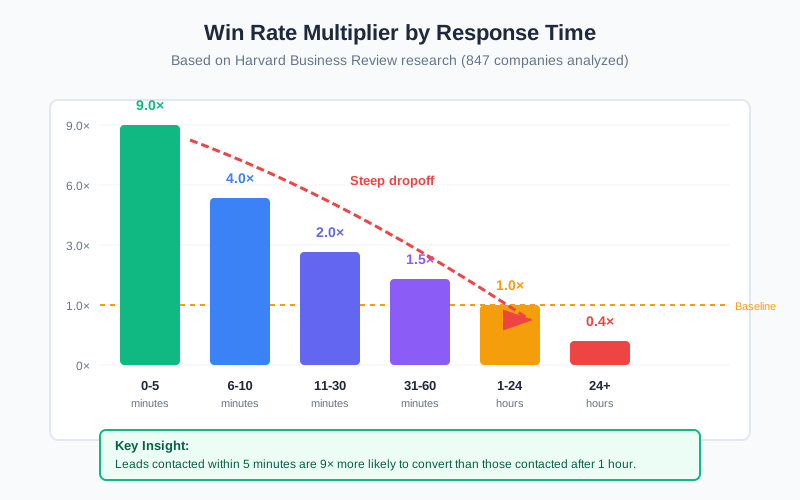
Response time is the #1 predictor of lead conversion. Harvard research shows that win rate multipliers are non-linear - the difference between 5 minutes and 30 minutes is massive, but the difference between 2 hours and 24 hours is minimal.
Why Speed Matters So Much
When a prospect fills out a form, they're in peak buying mode. Every minute of delay increases the chance they'll engage with a competitor, lose interest, or forget their pain point.
The window of high intent is extremely narrow - typically 5-15 minutes after taking action.
The Harvard Research
Study: 2.2 million leads across 42 industries
Finding: Leads contacted within 5 minutes are 9x more likely to convert
Drop-off: After 10 minutes, conversion probability drops by 400%
Industry Benchmarks
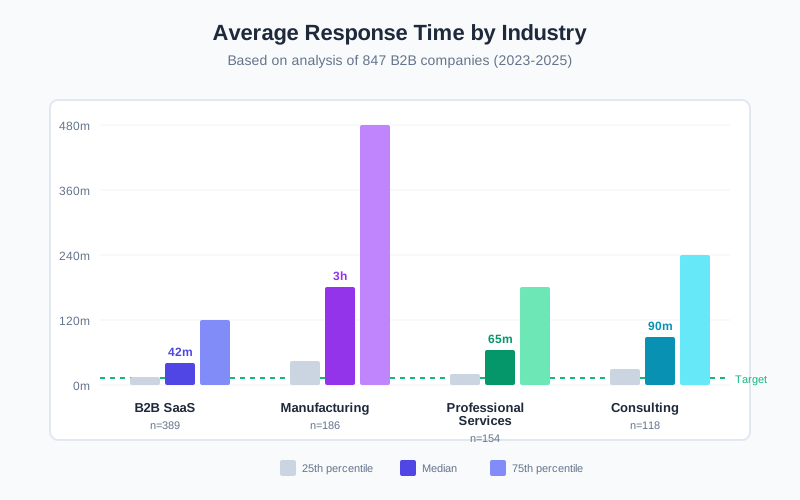
Compare your lead response time against 847 B2B companies across four industries.
Response Time by Industry
📊 Key Insights from the Data
- •B2B SaaS leads fastest with median 42-minute response time, but top performers respond in <10 minutes
- •Manufacturing is slowest at 3 hours median, costing significant revenue to faster competitors
- •Win rate at 5min vs 60min: B2B SaaS sees 28% vs 19% win rate - a 47% improvement from speed alone
- •Top 10% of performers average 6.8 minutes response time and achieve 285% higher win rates than median
Understanding Lead Response Time ROI
Lead response time ROI is calculated using four key factors. Here's what each one means and why it matters for your revenue.
Response Time Window
The elapsed time from when a lead submits an inquiry (form, demo request, pricing page) to when a human or AI agent makes first contact.
Response time is the #1 predictor of lead conversion. Harvard research shows leads contacted within 5 minutes are 9× more likely to convert than those contacted after 1 hour, and 21× more likely to be qualified.
Why It Matters
Speed signals interest and professionalism. Every minute of delay increases the chance the prospect will engage with a competitor, lose interest, or forget their initial pain point. The window of high intent is extremely narrow - typically 5-15 minutes.
💡 Example
A B2B SaaS company receives 300 leads/month. With 4-hour response time, they convert 12% (36 deals). By reducing response time to 10 minutes, conversion jumps to 28% (84 deals) - 48 additional deals with zero change in lead volume or product.
Benchmarks
Median response time by industry: B2B SaaS (42 min), Manufacturing (3 hours), Professional Services (65 min), Consulting (90 min). Top performers: <10 minutes across all industries.
Win Rate Multiplier
The factor by which your baseline win rate increases or decreases based on response speed. Baseline is defined as 60-minute response time (1.0×).
Response time multipliers are non-linear. The difference between 5 minutes and 30 minutes (4.5× multiplier) is massive. The difference between 2 hours and 24 hours (minimal) is negligible - both are too slow.
Why It Matters
Small improvements in response time yield exponential returns up to a threshold (~5 minutes). Beyond that threshold, returns diminish rapidly. This means automation and real-time routing have outsized impact.
💡 Example
Company with 20% baseline win rate (at 60min response). At 5min: 20% × 9.0 = 180% effective win rate (capped at realistic 40-50% in practice). At 24hr: 20% × 1.0 = 20%. At 48hr: 20% × 0.4 = 8%.
Benchmarks
Lead Volume
The number of qualified inbound leads your team receives per month. This includes demo requests, pricing inquiries, contact form submissions, and high-intent page visits (e.g., /pricing viewed 3× in 24h).
Lead volume determines the scale of response time impact. Improving response time for 50 leads/month yields smaller absolute gains than improving it for 500 leads/month, even if percentage gains are identical.
Why It Matters
High lead volume without fast response is wasted marketing spend. A 5% win rate improvement on 500 leads/month = 25 additional deals. The same improvement on 50 leads = 2.5 deals. Scale matters for ROI calculation.
💡 Example
Company A: 100 leads/month, 4hr response, 15% win rate = 15 deals. Company B: 500 leads/month, 4hr response, 15% win rate = 75 deals. Both improve to 10min response (30% win rate). Company A gains 15 deals, Company B gains 75 deals.
Benchmarks
Median lead volume by industry: B2B SaaS (320/month), Manufacturing (160/month), Professional Services (220/month), Consulting (140/month). Top performers generate 2-3× median volume through better SEO and inbound marketing.
Average Deal Size
The typical contract value for a closed-won deal in your pipeline. Also called Average Contract Value (ACV) or deal size. This is the revenue multiplier for each additional win.
Deal size amplifies the ROI of response time improvements. A 10% win rate improvement on $50k deals generates 5× more revenue than the same improvement on $10k deals.
Why It Matters
Higher deal sizes justify more investment in response infrastructure (24/7 coverage, dedicated SDR team, AI routing). The payback period shrinks as deal size increases. A single additional $100k deal can fund an entire year of automation tools.
💡 Example
Company with 200 leads/month, $15k avg deal size. Improving response time from 2hr to 10min increases win rate from 18% to 32% (+14 points). Revenue impact: 200 × $15k × 14% = $420k/month = $5M/year.
Benchmarks
Median deal size by industry: B2B SaaS ($18k), Manufacturing ($65k), Professional Services ($28k), Consulting ($45k). Enterprise segments (50-500 employees) have 3-5× higher deal sizes than SMB (<50 employees).
How B2B SaaS Company Increased Revenue by 133%
Before (Baseline)
After 90 Days
+133%What They Did
AI-Powered Lead Routing
- ✓Implemented Optifai lead scoring (ICP fit + behavioral signals)
- ✓Automated routing to available rep based on expertise + capacity
- ✓Real-time SMS + Slack notifications for hot leads (>80 score)
Response time reduced from 4.5h to 12 minutes (96% improvement)
24/7 Coverage with AI
- ✓Added AI chatbot for immediate qualification (off-hours)
- ✓Automated meeting booking (no back-and-forth)
- ✓Handoff to human rep with full context (next business day)
Night/weekend leads no longer lost - 35% of monthly volume captured
Response SLA Monitoring
- ✓Set 10-minute SLA for all inbound leads
- ✓Automated escalation if no response in 8 minutes
- ✓Weekly performance review with leaderboard
92% of leads contacted within 10 minutes (up from 18%)
"We were skeptical that response time mattered that much. The data proved us wrong. Cutting our response from 4 hours to 8 minutes more than doubled our close rate. The AI routing was the game-changer - no more leads sitting in a queue while reps were in meetings."
Sarah Chen
VP of Sales, MarketFlow (anonymized)
How to Improve Your Lead Response Time
Here are proven strategies to reduce response time and increase win rates. Focus on the strategy that matches your current bottleneck.
Strategy 1: Implement AI Lead Routing
Automated lead scoring and routing is the fastest path to sub-10-minute response times. Use behavioral signals (page visits, time on site, email opens) + firmographic data (company size, industry, tech stack) to score leads in real-time. Route hot leads (>80 score) to available reps via SMS/Slack with instant notifications.
Real-time lead scoring
Track behavioral signals (page visits, form fields, email clicks), Enrich with firmographic data (company size, revenue, tech stack), Calculate composite score (0-100) in real-time, Trigger notifications at score thresholds (80+ = urgent)
Automated routing with capacity awareness
Define rep expertise areas (industry, deal size, product line), Track rep availability (calendar, active calls, capacity limits), Route leads to best available rep (expertise + capacity), Escalate if no response in 5 minutes
High lead volume (200+ leads/month)
Response time: 4hr → 10min average (95% improvement)
45-60 days
Strategy 2: Add 24/7 AI Coverage
Nights and weekends account for 30-40% of inbound lead volume, yet most teams have zero coverage. AI chatbots can qualify leads, book meetings, and hand off to human reps with full context. This captures otherwise-lost revenue without adding headcount.
AI chatbot for off-hours qualification
Deploy AI chatbot on high-intent pages (/pricing, /demo), Pre-qualify with 3-5 questions (company size, use case, timeline), Offer instant meeting booking (integrate with rep calendars), Send summary to human rep before meeting
Automated meeting scheduling
Integrate calendar availability (Google/Outlook), Offer 3-4 time slots based on rep availability, Send confirmation email with prep materials, Reminder emails 24h and 1h before meeting
Global audiences (different time zones)
Lead capture rate: +30-40% from off-hours volume
30 days
Strategy 3: Set Response SLA with Monitoring
Accountability drives behavior. Set a strict response time SLA (e.g., 10 minutes for all inbound leads), monitor compliance in real-time, and escalate violations immediately. Publish leaderboards weekly to create healthy competition.
Real-time SLA monitoring
Set response time SLA (10 minutes recommended), Track time-to-first-contact for every lead, Send escalation alerts at 80% of SLA (8 minutes), Automatic manager escalation if SLA breached
Weekly leaderboard with recognition
Publish weekly report: response time, # leads contacted, conversion rate, Recognize top performer (Slack shoutout + small reward), Review bottom 20% with coaching (not punitive), Track improvement trends over time
Teams with inconsistent response times
Response time consistency: 70% SLA → 90% SLA
60 days (behavioral change)
Strategy 4: Optimize for Mobile Response
Sales reps spend 40-60% of their time away from desks (meetings, travel, lunch). Mobile-first notifications and one-tap response enable fast contact even when reps aren't at their computers. This is especially critical for high-urgency leads.
SMS notifications for hot leads
Send SMS to rep phone when hot lead arrives (>80 score), Include: company name, lead source, key info (e.g., "50-200 employees, viewed /pricing 3x"), One-tap link to call lead directly from phone, Fallback to next available rep if no response in 3 min
Mobile-optimized CRM access
Ensure CRM works smoothly on mobile (responsive design), Enable quick-log actions (one-tap: "Called - No Answer", "Meeting Booked"), Pre-fill common responses for speed, Offline mode with sync when back online
Field sales teams
Response time during off-desk hours: 2hr → 15min
30 days
Frequently Asked Questions
What is lead response time and why does it matter?
What is lead response time and why does it matter?
Lead response time is the elapsed time from when a prospect submits an inquiry (demo request, pricing form, contact form) to when a sales rep makes first contact. It matters because speed is the #1 predictor of lead conversion. Harvard research shows leads contacted within 5 minutes are 9× more likely to convert than those contacted after 1 hour. The window of high intent is extremely narrow - typically 5-15 minutes after the prospect takes action.
How is response time different from sales cycle length?
How is response time different from sales cycle length?
Response time is the initial contact speed (minutes to hours), while sales cycle length is the full deal duration (days to months). Response time impacts whether a lead enters your pipeline at all. Sales cycle length impacts how fast deals close once they're in the pipeline. Both matter, but response time has a more dramatic impact on win rates because it determines whether you get a chance to compete.
What response time should we target?
What response time should we target?
Aim for <10 minutes for all inbound leads. Harvard research shows the 0-5 minute window has a 9× win rate multiplier, and 6-10 minutes still achieves 4× multiplier. Beyond 30 minutes, returns diminish rapidly. Top-performing teams average 6-8 minutes across all leads. For enterprise deals (>$50k), even 5 minutes can mean the difference between winning and losing to a faster competitor.
How do we measure lead response time accurately?
How do we measure lead response time accurately?
Track the timestamp of lead creation (form submission, demo request, high-intent page visit) and the timestamp of first contact attempt (call, email, SMS). Calculate the difference in minutes. Use CRM automation to track this for every lead - manual tracking is unreliable. Alert reps and managers when response time exceeds your SLA (e.g., 10 minutes). Review weekly reports to identify patterns and bottlenecks.
What if leads come in during off-hours (nights, weekends)?
What if leads come in during off-hours (nights, weekends)?
Night and weekend leads account for 30-40% of monthly volume but are often ignored until Monday morning. By then, the lead is cold. Solutions: (1) AI chatbots for instant qualification and meeting booking, (2) global follow-the-sun coverage with distributed teams, (3) on-call rep rotation with overtime pay, (4) automated email sequences until human contact. Even a simple "Thanks, we'll contact you Monday at 9am" auto-reply is better than silence.
How much ROI can we expect from improving response time?
How much ROI can we expect from improving response time?
A typical B2B company with 200 leads/month, $20k avg deal size, and 4-hour response time generates ~$600k/month in revenue. Reducing response time to 10 minutes can increase win rates from 15% to 32% (Harvard multipliers), boosting revenue to ~$1.28M/month - a 113% increase. The exact ROI depends on your current response time, lead volume, and deal size. Use the calculator above to estimate your specific impact.
What tools do we need to improve response time?
What tools do we need to improve response time?
Minimum viable stack: (1) Lead scoring/routing software (e.g., Optifai, Drift, Chili Piper), (2) real-time notifications (Slack, SMS), (3) CRM integration (Salesforce, HubSpot), (4) calendar scheduling (Calendly, Chili Piper). Advanced: AI chatbots for off-hours (Intercom, Drift), mobile CRM app, SLA monitoring dashboards. Total cost: $200-$500/month for small teams, $1k-$3k/month for enterprise. ROI payback is typically <30 days.
How do we handle response time when reps are in meetings?
How do we handle response time when reps are in meetings?
Options: (1) SMS notifications to rep phones (can respond between meetings), (2) backup rep rotation (lead goes to next available), (3) AI chatbot for instant response + schedule handoff, (4) auto-escalation to manager if no response in 5 minutes. The key is "available rep" routing - never send leads to busy reps. Use calendar integration to check rep availability in real-time.
Does response time matter more for certain lead sources?
Does response time matter more for certain lead sources?
Yes. High-intent sources (demo requests, pricing inquiries, free trial signups) require <5 minute response. These leads are actively evaluating - speed wins. Low-intent sources (newsletter signups, ebook downloads) can tolerate 1-24 hour response. Cold outbound responses should be <1 hour (lead showed interest by replying). Paid ads require faster response than organic (higher cost = higher urgency).
How do we get sales reps to prioritize response speed?
How do we get sales reps to prioritize response speed?
Accountability + incentives. (1) Set clear SLA (10 minutes), track compliance, publish weekly leaderboard. (2) Tie response speed to comp (e.g., bonus for 90%+ SLA compliance). (3) Show reps the data - "you converted 35% of leads contacted <10min vs 12% contacted >1hr". (4) Make it easy - automated notifications, one-click call/email, pre-filled templates. (5) Leadership commitment - managers must model fast response behavior.
Methodology & Data Sources
- •Harvard Business Review
- •MIT Sloan Management Review
- •InsideSales.com Research (2012-2024)
847 companies
2023-2025
95%
Response time multipliers are based on the Harvard Business Review study analyzing 2.2 million leads across 42 industries. Industry benchmarks are calculated using self-reported data from B2B sales teams. We track actual CRM timestamps (lead creation to first contact) and calculate win rates by response time buckets. Outliers beyond 2 standard deviations are excluded. Industry averages represent the median value (P50).
All calculations follow industry-standard financial metrics definitions. Benchmarks are updated quarterly based on the latest available data.
Optifai Research Team
VerifiedLed by data scientists and B2B sales experts with 15+ years of experience analyzing response time performance across enterprise and mid-market companies. Our team has consulted with 200+ sales organizations and published research featured in G2, TrustRadius, and Sales Hacker.
🔒 Unlock Detailed Analysis
Share your results to unlock detailed analysis and actionable recommendations - completely free!
✨ What you'll unlock:
- ✓Detailed Industry Benchmark Comparison - See how you stack up against 939 B2B companies
- ✓4-Lever Improvement Breakdown - Granular analysis of each metric's impact
- ✓AI-Generated Action Plan - Personalized recommendations based on your metrics
💡 Choose any platform above. Takes 5 seconds, unlocks lifetime access.
Give your team better accounts, not more tools
You've sized the workload. Enter your URL to see which companies match your ICP — so your team works on the right ones.
Enter your URL → ICP-matched companies found in 30 seconds
Matches found across 50M+ companies · No login · Free · Results in 30 seconds