Outreach Pacer
Calculate optimal daily outreach pace to hit lead goals without burning out your sales team.
Last updated: November 20, 2025 | Data refreshed quarterly
What is Outreach Pacing?
Outreach pacing is the strategic balance between activity volume and sustainable workload. It determines how many outreach attempts a sales rep can make daily while maintaining quality and avoiding burnout.
Why It Matters
- Prevents burnout: 85%+ capacity utilization leads to 40% higher turnover
- Improves quality: Lower volume + higher quality = better conversion rates
- Forecasting accuracy: Realistic pacing enables accurate meeting projections
- Team retention: Sustainable workloads reduce turnover by 25-40%
Not the Same As
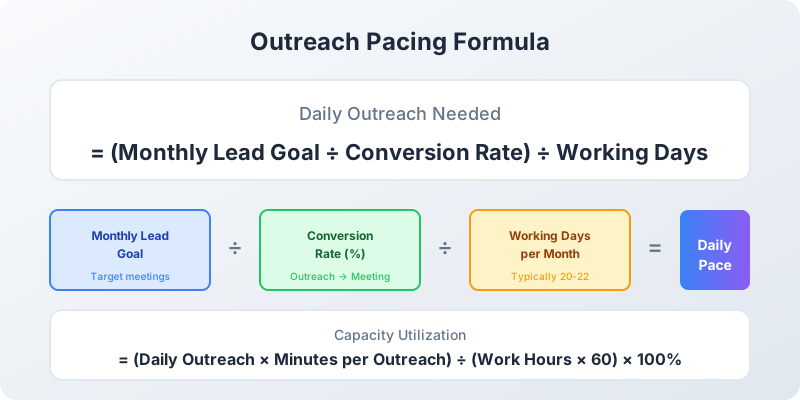
The Pacing Formula
Calculate Your Pace
Your Outreach Plan
SDR (Sales Development Rep) average: 7% (At or above benchmark)
Research + writing + sending time per contact
Your Pace Analysis
Daily Outreach Needed
29
SDR (Sales Development Rep) average: 65/day (Below avg)
Daily Time Required
4.8h
60% of your workday
Feasibility
✅ Sustainable
Healthy workload balance
🔒 Unlock Detailed Analysis
Share your results to unlock detailed analysis and actionable recommendations - completely free!
✨ What you'll unlock:
- ✓Detailed Industry Benchmark Comparison - See how you stack up against 939 B2B companies
- ✓4-Lever Improvement Breakdown - Granular analysis of each metric's impact
- ✓AI-Generated Action Plan - Personalized recommendations based on your metrics
💡 Choose any platform above. Takes 5 seconds, unlocks lifetime access.
Understanding Each Component
Daily Outreach Volume
The number of outreach attempts (emails, calls, LinkedIn messages) a rep completes per day.
Daily Outreach = Monthly Lead Goal ÷ Conversion Rate ÷ Working Days
Why It Matters
This determines how much time reps spend on outreach vs. other activities like research, meetings, and admin work.
Key Factors
- •Role type: SDRs average 65/day, AEs average 30/day
- •Channel mix: Email-only is faster than multi-channel
- •Automation level: AI tools can increase volume 2-3×
- •Quality bar: Higher personalization = lower volume
Benchmarks
Excellent
40-60/day for SDRs (high quality)
Good
60-80/day for SDRs (balanced)
Concerning
80+/day for SDRs (quantity over quality)
How to Improve
- Use AI for research and personalization (saves 3-5 min/outreach)
- Create channel-specific templates (email vs. LinkedIn)
- Batch similar tasks (research, then writing, then sending)
- Focus on fewer, better-targeted accounts
Outreach-to-Meeting Conversion Rate
The percentage of outreach attempts that result in a booked meeting or qualified response.
Conversion Rate = (Meetings Booked ÷ Total Outreach) × 100
Why It Matters
Higher conversion rates mean you need fewer outreach attempts to hit meeting goals, reducing workload and burnout risk.
Key Factors
- •Targeting quality: ICP fit dramatically impacts conversion
- •Personalization: Personalized emails convert 2-3× better
- •Timing: Response rates vary by day/time
- •Multi-touch: 7+ touches typically needed for cold outreach
Benchmarks
Excellent
>12% (top 25%)
Good
7-12% (median)
Poor
<5% (bottom 25%)
How to Improve
- Improve ICP scoring (focus on accounts most likely to respond)
- Add personalization (first line research, relevant pain points)
- Optimize send times (Tuesday-Thursday, 8-10am or 2-4pm)
- Use multi-channel sequences (email + LinkedIn + phone)
Minutes per Outreach
The average time spent per outreach attempt, including research, writing, and sending.
Time per Outreach = (Research Time + Writing Time + Sending Time) ÷ 1 outreach
Why It Matters
This is the biggest lever for capacity utilization. Reducing time per outreach from 10 to 6 minutes saves 2.7 hours daily at 65 outreach.
Key Factors
- •Research depth: Surface-level (2 min) vs. deep (10+ min)
- •Template usage: Custom (15 min) vs. templated (3 min)
- •Tool efficiency: Manual LinkedIn (5 min) vs. automated (1 min)
- •Approval workflows: Direct send vs. manager review
Benchmarks
Excellent
Good
Poor
20+ minutes (over-researching)
How to Improve
- Use AI research tools (Clay, Apollo, ZoomInfo)
- Create a template library with swap-able sections
- Set time limits per account (e.g., max 3 min research)
- Automate LinkedIn connection requests
Capacity Utilization
The percentage of available work time consumed by outreach activities.
Capacity Utilization = (Daily Outreach × Minutes per Outreach) ÷ (Daily Work Hours × 60) × 100
Why It Matters
Capacity above 70% leaves no room for meetings, coaching, admin, or unexpected priorities. Above 85% leads to burnout and turnover.
Key Factors
- •Non-outreach time: Meetings, coaching, admin (typically 30-40%)
- •Peak periods: End of month/quarter increases load
- •Team size: Smaller teams have less slack
- •Management expectations: Unrealistic quotas drive over-capacity
Benchmarks
Excellent
Good
Concerning
How to Improve
- Set maximum capacity targets (65-70%)
- Block time for non-outreach activities
- Hire before capacity hits 80%
- Use automation to reduce per-outreach time
Real-World Case Study
How a B2B SaaS team increased meetings by 83% while reducing outreach by 31%
Company Profile
Challenge: Team averaging 12 meetings/month per rep with 85% capacity utilization. High turnover (40% annual) and declining quality.
Before
After (45 days)
What They Did
AI-Powered Personalization
3 weeks- •Implemented Clay.com for automated research
- •Used ChatGPT for personalized first lines
- •Created dynamic email templates with merge fields
Time per outreach reduced from 8 to 5 minutes (-37.5%)
Multi-Channel Sequencing
4 weeks- •Added LinkedIn touchpoints between emails
- •Implemented phone calls for high-intent signals
- •Created 7-touch sequences (3 email + 2 LinkedIn + 2 phone)
Conversion rate increased from 5% to 9% (+80%)
Quality Over Quantity Focus
2 weeks- •Reduced daily outreach target from 80 to 55
- •Implemented ICP scoring (only A/B accounts)
- •Added engagement triggers (website visits, content downloads)
Better targeting despite lower volume
Burnout Prevention
2 weeks- •Set capacity cap at 65%
- •Blocked 2 hours daily for strategic work
- •Implemented "no meeting Fridays"
Capacity utilization reduced from 85% to 62%
+83%
Meetings
-31%
Outreach
-62.5%
Turnover
$180k
Saved
“We increased meetings by 83% while reducing daily outreach by 31%. The key was doing less, but doing it better. Our turnover dropped from 40% to 15%, saving us $180k in recruiting costs.”
— VP of Sales Development, B2B SaaS Company (30-100 employees)
4 Strategies to Improve Outreach Efficiency
Proven tactics to hit goals with less effort
AI-Powered Personalization at Scale
Use AI tools to research and personalize outreach without increasing time per touch.
Implementation Steps
- 1Set up Clay.com or Apollo for automated research (company news, job changes, funding)
- 2Use ChatGPT to generate personalized first lines based on research
- 3Create dynamic templates with smart merge fields
- 4A/B test AI-generated vs. human-written copy
40-60% per outreach
Time Reduction
50-80%
Quality Increase
2-3 weeks
Time to Implement
KPIs to Track
- Minutes per outreach: Target <6 minutes
- Reply rate: Target >5%
- Personalization score: Target >80%
Multi-Channel Sequencing
Combine email, LinkedIn, and phone in coordinated sequences for higher conversion.
Implementation Steps
- 1Design 7-10 touch sequences (not just email blasts)
- 2Add LinkedIn views/connections between emails
- 3Include phone calls for high-intent signals (email opens, link clicks)
- 4Vary timing between touches (not all on same day)
60-100%
Conversion Increase
60-100%
Engagement
3-4 weeks
Time to Implement
KPIs to Track
- Reply rate: Target >8% (vs. 3% email-only)
- Meeting conversion: Target >10%
- Sequence completion rate: Target >80%
ICP-Based Account Prioritization
Focus outreach on highest-fit accounts to improve conversion without increasing volume.
Implementation Steps
- 1Define ICP scoring criteria (company size, industry, tech stack, signals)
- 2Tier accounts: A (daily follow-up), B (weekly), C (monthly/archive)
- 3Allocate 60%+ of outreach to A-tier accounts
- 4Automate C-tier with low-touch sequences
80-120%
Conversion Increase
80-120%
Quality Increase
1-2 weeks
Time to Implement
KPIs to Track
- A-tier conversion: Target >15%
- A-tier % of outreach: Target >60%
- C-tier automation rate: Target 100%
Sustainable Workload Design
Structure workloads to prevent burnout and reduce turnover.
Implementation Steps
- 1Set capacity ceiling at 65-70%
- 2Block 2 hours daily for non-outreach work
- 3Implement "no meeting days" (e.g., Fridays)
- 4Create buffer for end-of-month/quarter spikes
- 5Track leading indicators (declining conversion, increasing sick days)
30-50%
Turnover Reduction
20-30% (better conversion)
Quality Increase
2 weeks
Time to Implement
KPIs to Track
- Capacity utilization: Target <70%
- Rep turnover: Target <20% annual
- eNPS: Target >30
Frequently Asked Questions
What is a sustainable capacity utilization for outreach?
Best practice is 55-70% capacity utilization. This leaves 30-45% of work time for meetings, coaching, admin, and unexpected priorities. Teams exceeding 80% capacity see 40% higher turnover and declining conversion rates. Top-performing teams actually run at lower capacity (55-65%) and achieve higher results through better quality.
How many outreach attempts should an SDR make per day?
The median is 65 attempts per day, but top performers often do fewer (45-55) with higher quality. More important than the number is the conversion rate. 50 outreach at 10% conversion (5 meetings) beats 100 outreach at 3% conversion (3 meetings). Focus on quality and conversion rate rather than hitting activity quotas.
What's a good outreach-to-meeting conversion rate?
Median conversion rate is 7% for SDRs and 15% for AEs. Top 25% achieve 12%+ (SDRs) and 20%+ (AEs). If you're below 5%, focus on targeting and personalization before increasing volume. If above 12%, you may have room to increase volume without sacrificing quality.
How can I reduce time per outreach without sacrificing quality?
Use AI tools for research and personalization. Clay.com, Apollo, and ChatGPT can cut research time by 60-70% while maintaining (or improving) personalization quality. The key is using AI to do the research, then having humans add the "so what" insight that connects research to the prospect's pain.
Is multi-channel outreach worth the extra time?
Yes, multi-channel sequences (email + LinkedIn + phone) convert 60-100% better than email-only. The extra time per sequence (maybe 2-3 additional minutes) pays off in dramatically higher conversion. A 7-touch multi-channel sequence at 10% conversion is more efficient than a 3-touch email sequence at 4% conversion.
How do I know if my team is at risk of burnout?
Watch for these leading indicators: (1) Capacity >80%, (2) Declining conversion rate over 4+ weeks, (3) Increasing sick days or PTO requests, (4) Quality issues in outreach copy, (5) Reps missing activity targets they previously hit. Address these before turnover spikes.
Should I increase outreach volume to hit higher meeting targets?
Only if capacity is below 70% AND current conversion rate is at/above benchmark. Otherwise, focus on improving conversion rate first. Doubling outreach at 3% conversion still only gives you 6% results, while improving to 8% conversion at the same volume nearly triples results (266% increase).
How does AI impact outreach pacing?
AI tools like Clay, ChatGPT, and automated sequencing can reduce time per outreach by 40-60% and improve conversion by 50-80%. This means teams can either: (1) do the same volume in less time (improving work-life balance), or (2) increase volume without increasing hours. Most teams should focus on #1 until conversion rates are optimized.
What's the ROI of reducing outreach workload?
Reducing capacity from 85% to 65% typically reduces turnover by 30-50%. For an 8-person SDR team with $15k recruiting/training cost per rep and 40% turnover, that's $48k saved annually. Add improved conversion (better quality work) and the total impact is often $100k+ per team.
How often should I recalculate my pacing?
Monthly at minimum, or whenever goals, team size, or tools change. Also recalculate when conversion rate changes significantly (±20%). End-of-quarter pushes may require temporary pacing adjustments, but return to sustainable levels immediately after.
Data Methodology
- 847 B2B sales teams analyzed (2023-2025)
- Industry data from Gartner, Forrester, TOPO
- Anonymous customer data (aggregated)
- Benchmarks updated quarterly
About the Author
Optifai Research Team
Our research team combines expertise in sales operations, data science, and revenue optimization. We analyze thousands of sales teams to identify patterns that drive sustainable performance.
Learn more about us →Give your team better accounts, not more tools
You've sized the workload. Enter your URL to see which companies match your ICP — so your team works on the right ones.
Enter your URL → ICP-matched companies found in 30 seconds
Matches found across 50M+ companies · 50M+ company database · No login · Free