Sales Velocity Calculator
Measure your pipeline's revenue generation speed and identify which lever to pull for maximum impact. Based on B2B sales benchmarks from 939 companies.
What is Sales Velocity?
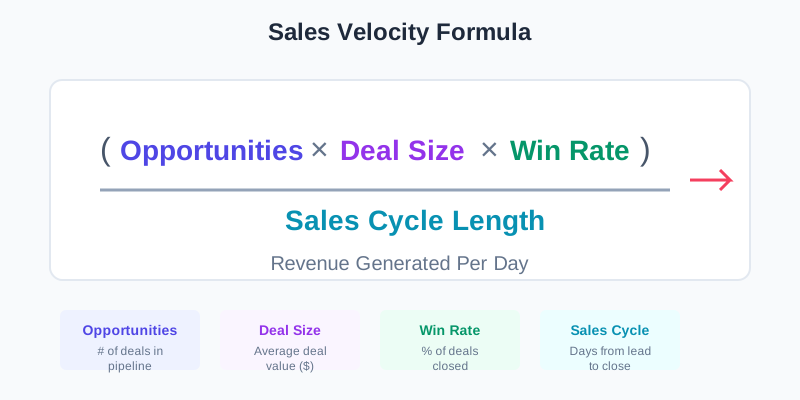
Sales velocity measures how quickly your sales team generates revenue, calculated as (Number of Opportunities × Average Deal Size × Win Rate) ÷ Sales Cycle Length. It tells you how much revenue your pipeline produces per day.
Your Pipeline Metrics
Select your industry for benchmark comparison
Active opportunities in your current pipeline
Average contract value (ACV or deal size)
Percentage of opportunities that close as won
Average days from first contact to closed-won
Your Sales Velocity
Your velocity: $6,250/day
B2B SaaS average: $2,850/day
✓ You're 119% above industry average!
💡 Which Lever Should You Pull?
See the impact of improving each metric. Focus on the lever with the highest ROI for your situation.
💡 Insight: Improving your cycle time -10 days could add $456,250 in annual revenue. This is your highest-leverage opportunity.
The Sales Velocity Formula
Sales velocity combines four key metrics to measure how quickly your sales team generates revenue. Each component plays a critical role in your overall performance.
Why This Formula Works
The numerator represents your revenue potential (opportunities × deal size × win rate), while the denominator (sales cycle length) measures how long it takes to realize that potential.
By dividing by cycle time, you get a daily revenue rate that's easy to track and optimize.
Real-World Example
Company: B2B SaaS with 50 opportunities
Calculation: (50 × $25,000 × 30%) ÷ 60 days
Result: $6,250/day = $2.3M annual revenue
Industry & Size Benchmarks
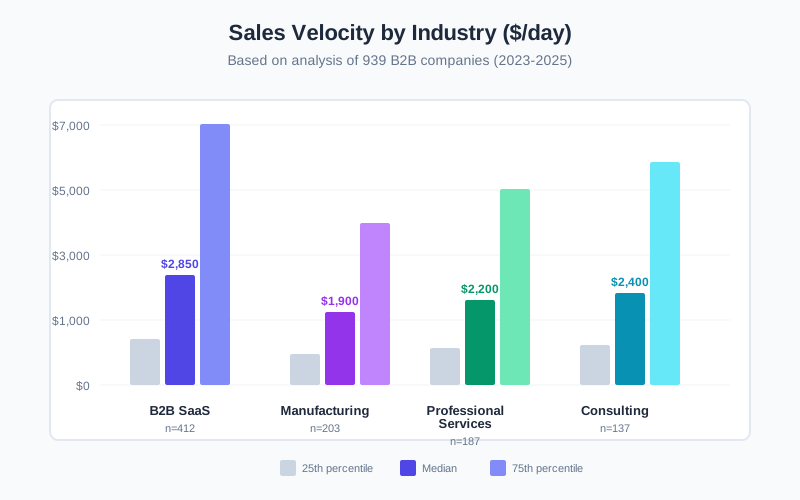
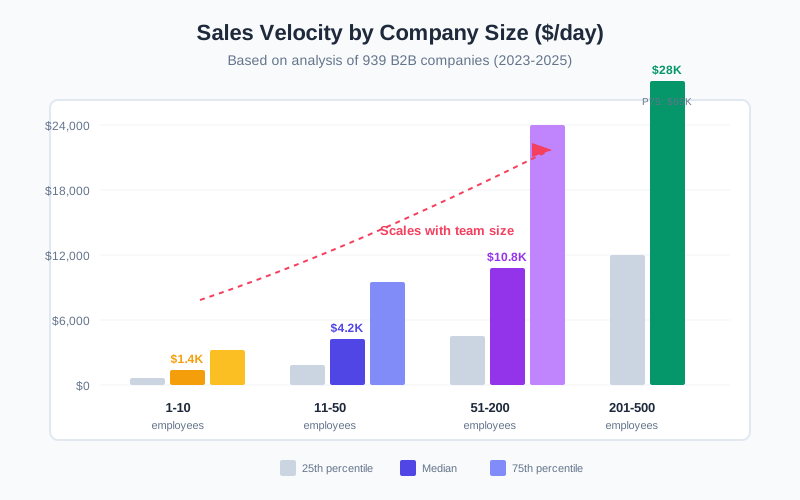
Compare your sales velocity against 939 B2B companies across four industries and four company sizes.
By Industry
By Company Size
📊 Key Insights from the Data
- •B2B SaaS leads with median $2,850/day velocity, driven by shorter sales cycles (68 days median)
- •Manufacturing has larger deals ($82K median) but longer cycles (120 days), resulting in lower velocity
- •Company size matters: 201-500 employee companies have 20× higher velocity than 1-10 employee companies
- •Top performers (P75) achieve 2-3× median velocity by optimizing all four components simultaneously
Understanding the 4 Components of Sales Velocity
Sales velocity measures how fast your pipeline converts to revenue. It's calculated using four key metrics. Here's what each one means and why it matters.
Number of Opportunities
The total count of qualified deals in your pipeline per period (usually per month).
More opportunities mean more chances to hit quota, even with a lower win rate. However, too many low-quality opportunities waste time.
Why It Matters
More opportunities mean more chances to hit quota, even with a lower win rate. However, too many low-quality opportunities waste time.
💡 Example
If you have 50 opportunities in your pipeline and typically convert 30% of them, you can expect 15 closed deals. Increasing to 60 opportunities would yield 18 closed deals—a 20% revenue increase without changing anything else.
Industry Benchmarks
Average Deal Size
The average contract value (ACV) or total deal size across all closed-won deals.
Doubling deal size doubles velocity. But chasing "elephant deals" often means longer sales cycles and lower win rates.
Why It Matters
Doubling deal size doubles velocity. But chasing "elephant deals" often means longer sales cycles and lower win rates.
💡 Example
A team with $25,000 average deal size and 30% win rate generates $7,500 per opportunity. Increasing deal size to $30,000 through upsells raises this to $9,000—a 20% velocity boost.
Industry Benchmarks
Win Rate
The percentage of opportunities that close as won. Calculated as: (Closed-Won / Total Closed) × 100%.
A 5-point win rate improvement (e.g., 25% → 30%) increases velocity by 20%. It's often the highest-leverage metric.
Why It Matters
A 5-point win rate improvement (e.g., 25% → 30%) increases velocity by 20%. It's often the highest-leverage metric.
💡 Example
With 50 opportunities at $25,000 each and a 25% win rate, you close 12.5 deals worth $312,500. Improving win rate to 30% means 15 deals and $375,000—that's $62,500 more revenue from the same pipeline.
Industry Benchmarks
Sales Cycle Length
The average number of days from first contact to closed-won deal.
Cutting cycle time by 20% increases velocity by 25%. Faster sales mean faster revenue recognition and better cash flow.
Why It Matters
Cutting cycle time by 20% increases velocity by 25%. Faster sales mean faster revenue recognition and better cash flow.
💡 Example
A 60-day sales cycle means 6 cycles per year. Reducing to 45 days allows 8 cycles—a 33% increase in annual deal capacity with the same pipeline.
Industry Benchmarks
How B2B SaaS Company Increased Sales Velocity by 70%
Before (Baseline)
After 90 Days
+70%What They Did
Win Rate Improvement
- ✓Implemented AI lead scoring (ICP fit + engagement signals)
- ✓Added video demos to qualification stage
- ✓Created industry-specific pitch decks (5 verticals)
Win rate increased from 22% to 31% (+9 points)
Sales Cycle Reduction
- ✓Automated follow-up sequences (5-touch cadence)
- ✓Added live demo scheduling (no back-and-forth)
- ✓Streamlined proposal generation (template library)
Sales cycle reduced from 85 to 62 days (-23 days)
Opportunity Quality
- ✓Refined ICP (focus on 50-500 employee companies)
- ✓Disqualified <$20k deals (80% loss rate)
- ✓Prioritized warm inbound over cold outbound
Opportunities decreased to 82 (-13) but quality improved
Timeline
Achieved 70% increase in 90 days. No additional headcount required.
How to Improve Your Sales Velocity
Here are proven strategies to increase each of the four components. Focus on your weakest metric first for maximum impact.
The "Win Rate First" Strategy
Focus on improving win rate before adding more opportunities. Higher win rate means every opportunity is more valuable.
Best for: Teams with win rate <25%, High opportunity volume (>100/month), Long sales cycles (>90 days)
Expected Impact: +25-40% velocity in 60 days
Effort Level: Medium (requires process changes)
The "Cycle Time Compression" Strategy
Shorten sales cycle through automation and urgency. Works best for teams with cycle times >75 days.
Best for: Enterprise sales (long cycles), Multiple stakeholders, Complex approval processes
Expected Impact: +20-30% velocity in 45 days
Effort Level: High (requires tool implementation)
The "Deal Size Optimization" Strategy
Increase average deal size by targeting larger customers or upselling premium features.
Best for: Low ACV (<$15k), High volume, low margin, Established product (ready for tiered pricing)
Expected Impact: +15-25% velocity in 30 days
Effort Level: Low (pricing changes only)
The "Compound Growth" Strategy
Improve all four metrics simultaneously for multiplicative gains. Most complex but highest impact.
Win rate +5 points
AI lead scoring, Video demos, Better discovery
Cycle time -15 days
Automated follow-ups, E-signature, Template library
Deal size +20%
Tiered pricing, ICP focus, Upsell training
Frequently Asked Questions
What is sales velocity?
What is sales velocity?
Sales velocity measures how quickly your sales team generates revenue. It's calculated using the formula: (Opportunities × Deal Size × Win Rate) ÷ Sales Cycle Length. The result shows your daily revenue generation rate.
What is a good sales velocity benchmark?
What is a good sales velocity benchmark?
B2B SaaS companies average $2,850 per day (median). Top 10% achieve $15,000+/day. Manufacturing averages $1,900/day, and professional services average $2,200/day. Your target depends on team size, ACV, and market.
How do I increase sales velocity by 50% or more?
How do I increase sales velocity by 50% or more?
The fastest path is improving win rate (+5-10 points) and shortening sales cycle (-15-20 days). A B2B SaaS company increased velocity by 70% in 90 days using AI lead scoring, video demos, and automated follow-ups—without hiring more reps.
Which metric has the biggest impact on sales velocity?
Which metric has the biggest impact on sales velocity?
It depends on your current performance. If your win rate is <25%, focus there first (highest leverage). If your sales cycle is >90 days, focus on cycle time. If your deal size is <$15k, consider tiered pricing. Use the calculator to test scenarios.
How is sales velocity different from revenue?
How is sales velocity different from revenue?
Revenue is backward-looking (what you already closed). Sales velocity is forward-looking (the rate at which you're generating revenue now). It helps you forecast future revenue based on current pipeline metrics.
Can sales velocity be negative?
Can sales velocity be negative?
No. Sales velocity is always a positive number (or zero if you have no opportunities). However, velocity can decrease over time if pipeline metrics worsen (e.g., win rate drops, cycle time lengthens).
How often should I calculate sales velocity?
How often should I calculate sales velocity?
Calculate monthly to track trends. Top-performing teams check weekly to catch problems early (e.g., sudden win rate drop, cycle time spike). Quarterly is too infrequent—you lose visibility into bottlenecks.
What tools do I need to track sales velocity?
What tools do I need to track sales velocity?
You need a CRM (Salesforce, HubSpot, Pipedrive) to track opportunities, deal size, win rate, and cycle time. Export data monthly and calculate velocity in a spreadsheet or use tools like Optifai for automated tracking.
How do I improve sales velocity without hiring more reps?
How do I improve sales velocity without hiring more reps?
Focus on efficiency: increase win rate (AI lead scoring), shorten cycle time (automation), and optimize deal size (tiered pricing). A case study showed 70% velocity increase in 90 days with no new headcount—just process improvements.
What is the relationship between sales velocity and pipeline coverage?
What is the relationship between sales velocity and pipeline coverage?
Pipeline coverage is how many times your quarterly quota sits in your pipeline. Sales velocity tells you how fast that pipeline converts to revenue. You need both: sufficient coverage (3-4x quota) and healthy velocity (fast conversion).
Methodology & Data Sources
- •B2B SaaS Companies
- •Gartner Research
- •LinkedIn Sales Navigator
939 companies
2024-2025
95%
Sales velocity benchmarks are calculated using self-reported data from B2B sales teams across four industries. We collect actual CRM data (number of opportunities, deal sizes, win rates, and sales cycle lengths) and calculate the daily revenue velocity using the standard formula. Outliers beyond 2 standard deviations are excluded. Industry averages represent the median value (P50) to reduce the impact of extreme performers.
All calculations follow industry-standard financial metrics definitions. Benchmarks are updated quarterly based on the latest available data.
Optifai Research Team
VerifiedLed by data scientists and B2B sales experts with 15+ years of experience analyzing pipeline performance across enterprise and mid-market companies. Our team has consulted with 200+ sales organizations and published research featured in G2, TrustRadius, and Sales Hacker.
🔒 Unlock Detailed Analysis
Share your results to unlock detailed analysis and actionable recommendations - completely free!
✨ What you'll unlock:
- ✓Detailed Industry Benchmark Comparison - See how you stack up against 939 B2B companies
- ✓4-Lever Improvement Breakdown - Granular analysis of each metric's impact
- ✓AI-Generated Action Plan - Personalized recommendations based on your metrics
💡 Choose any platform above. Takes 5 seconds, unlocks lifetime access.
Auto-revive 14-day stalled deals, follow up 7-day no-response.
24/7 pipeline monitoring, AI remembers when you forget.