Pipeline Conversion Rate Gap Calculator
Identify which stage of your sales pipeline needs improvement. Compare your conversion rates against industry benchmarks to find your biggest leak and prioritize optimization efforts.
What is Pipeline CVR Gap Analysis?
Pipeline CVR gap analysis identifies which stage of your sales funnel has the largest conversion rate gap compared to industry benchmarks. By finding your "weakest link" (the stage where you underperform most), you can prioritize improvements for maximum pipeline impact. Typical B2B total conversion rates range from 1.5-3.5% (Lead to Won).
Understanding Pipeline Conversion

Your Conversion Rates
Benchmark: 25%
Benchmark: 40%
Benchmark: 60%
Benchmark: 30%
Diagnostic Results
Stage-by-Stage Gap Analysis
🔒 Unlock Detailed Analysis
Share your results to unlock detailed analysis and actionable recommendations - completely free!
✨ What you'll unlock:
- ✓Detailed Industry Benchmark Comparison - See how you stack up against 939 B2B companies
- ✓4-Lever Improvement Breakdown - Granular analysis of each metric's impact
- ✓AI-Generated Action Plan - Personalized recommendations based on your metrics
💡 Choose any platform above. Takes 5 seconds, unlocks lifetime access.
Industry Benchmarks
Understanding Each Pipeline Stage
Lead → MQL Conversion
Percentage of raw leads that become Marketing Qualified Leads
(MQLs ÷ Total Leads) × 100MQL → SQL Conversion
Percentage of Marketing Qualified Leads accepted by sales as Sales Qualified
(SQLs ÷ MQLs) × 100SQL → Opportunity Conversion
Percentage of Sales Qualified Leads that become pipeline opportunities
(Opportunities ÷ SQLs) × 100Opportunity → Closed Won
Percentage of pipeline opportunities that close as won deals
(Won Deals ÷ Total Opportunities) × 100Case Study: 150% CVR Improvement in 8 Weeks
B2B SaaS (MarTech) • 85 employees
Before
After (8 weeks)
Key Lessons
- ✓Focus on the weakest stage first - MQL→SQL improvement drove 60% of total gain
- ✓Marketing-sales alignment on lead definition was foundational - everything else built on this
- ✓Speed matters: 5-min response SLA alone improved MQL→SQL by 6%
- ✓ROI calculator reduced "no decision" losses by helping champions build internal business cases
Improvement Strategies
Intent-Based Lead Scoring
Replace demographic-only scoring with behavioral signals. Companies using intent data see 40% higher Lead→MQL conversion
Marketing-Sales SLA & Handoff
Create formal SLA with response time commitments and feedback loops. Teams with SLAs see 38% higher MQL→SQL conversion
Standardized Discovery Framework
Implement consistent discovery methodology (MEDDIC, BANT, SPIN). Teams with frameworks convert 25% more SQLs to Opps
ROI Calculator for Buyers
Give prospects a tool to build their internal business case. Deals with ROI justification close 28% more often
Frequently Asked Questions
What is a good pipeline conversion rate?
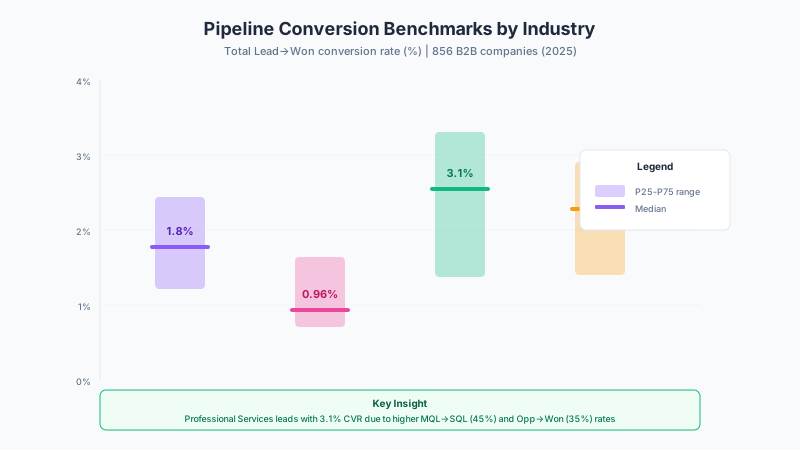
Total pipeline conversion (Lead→Won) varies significantly by industry: B2B SaaS averages 1.8%, Manufacturing 0.96%, Professional Services 3.1%, and Consulting 2.3%. Top performers achieve 2.5-3x these averages. More important than absolute rate is your performance vs. industry benchmark and improvement trend. Focus on closing the gap at your weakest stage first—this typically delivers the highest ROI.
Which pipeline stage should I optimize first?
Always start with your weakest stage (largest gap vs. benchmark). In our case study, fixing a 12% gap in MQL→SQL delivered 60% of total improvement. Use this priority framework: (1) Calculate gap at each stage, (2) Prioritize largest gaps, (3) Consider effort: early stages are often easier to fix, (4) Check downstream impact—early stage improvements compound. Most companies have their biggest leak at MQL→SQL (marketing-sales handoff).
How do I calculate total pipeline conversion rate?
Total CVR = Stage 1 × Stage 2 × Stage 3 × Stage 4. Example: 25% × 40% × 60% × 30% = 1.8%. This shows why small improvements compound: improving each stage by 5% (to 30% × 45% × 65% × 35%) yields 3.3% total CVR—an 83% improvement. Our calculator breaks down each stage to identify exactly where your pipeline leaks.
What causes low MQL to SQL conversion?
The top causes are: (1) Marketing-sales misalignment on what makes a qualified lead (fix: joint definition workshop), (2) Slow response time—leads contacted after 30 min are 21x less likely to convert (fix: 5-min SLA), (3) No nurturing for "not-ready" leads (fix: automated nurture sequences), (4) Poor handoff process losing context (fix: standardized handoff with required fields). Companies that address all four see 30-40% improvement.
How do I improve opportunity win rate?
Focus on three areas: (1) Competitive positioning—reps with battle cards win 12% more competitive deals. (2) Business case—deals with ROI justification close 28% more often; create calculators champions can use internally. (3) Procurement—mutual action plans reduce "stuck" deals by 35%. Also analyze lost deal reasons monthly. The #1 lost reason for most companies is "no decision" (status quo wins), which ROI calculators directly address.
What is a good Lead to MQL conversion rate?
Industry averages: B2B SaaS 25%, Manufacturing 20%, Professional Services 30%, Consulting 28%. Range from poor (15%) to excellent (35%). Key drivers: lead source quality (inbound converts 3-5x better than purchased lists), scoring accuracy (intent-based outperforms demographic by 40%), and response time (5-min response increases qualification 21x). Improve by: cutting low-quality sources, adding intent signals to scoring, instant lead routing.
How long does it take to improve conversion rates?
Timeline by improvement type: Quick wins (1-2 weeks): Response time SLA, lead routing, basic nurture sequences. Medium effort (3-4 weeks): Lead scoring optimization, discovery frameworks, battle cards. Comprehensive (6-8 weeks): Full funnel optimization including marketing-sales alignment. Our case study achieved 150% improvement in 8 weeks. Most teams see measurable improvement within 30 days by focusing on their weakest stage.
How do I reduce "no decision" lost deals?
"No decision" (status quo wins) is the #1 lost reason for B2B companies. Reduce it by: (1) ROI calculator—help champions build internal business cases (28% improvement), (2) Mutual action plans—create shared accountability with buyer (35% reduction in stuck deals), (3) Multi-threading—engage 3+ stakeholders to build consensus (40% better conversion), (4) Identify compelling event—tie solution to business deadline or initiative. Our case study reduced no-decision losses by 38%.
What data do I need to calculate pipeline conversion?
You need: (1) Lead volume by source, (2) MQL count (however you define MQL), (3) SQL count (sales-accepted leads), (4) Opportunity count (deals in pipeline), (5) Won deal count. Pull this from CRM. Calculate: Lead→MQL, MQL→SQL, SQL→Opp, Opp→Won rates. Also track: cycle length by stage, lost deal reasons, and conversion by lead source/segment. Most CRMs have funnel reports that provide this automatically.
Should I use MEDDIC or BANT for qualification?
Depends on deal complexity and cycle length. BANT (Budget, Authority, Need, Timeline): Best for SMB, shorter cycles (<30 days), deals <$20K. Simple and fast. MEDDIC (Metrics, Economic Buyer, Decision Criteria, Decision Process, Identify Pain, Champion): Best for Enterprise, longer cycles (60+ days), deals >$50K. More thorough. Some teams use both: BANT for initial qualification, MEDDIC for opportunity development. The key is consistent use—any framework beats none.
Revive 14-day stalled deals, follow up 7-day no-response.
24/7 pipeline monitoring, AI remembers when you forget.
Calculation Methodology
- Total conversion rate: Product of all stage conversion rates
- Gap analysis: Your rate - Industry benchmark
- Benchmarks: Median values from 856 B2B companies (2025)
- Data sources: Salesforce, HubSpot, Gartner, Forrester